
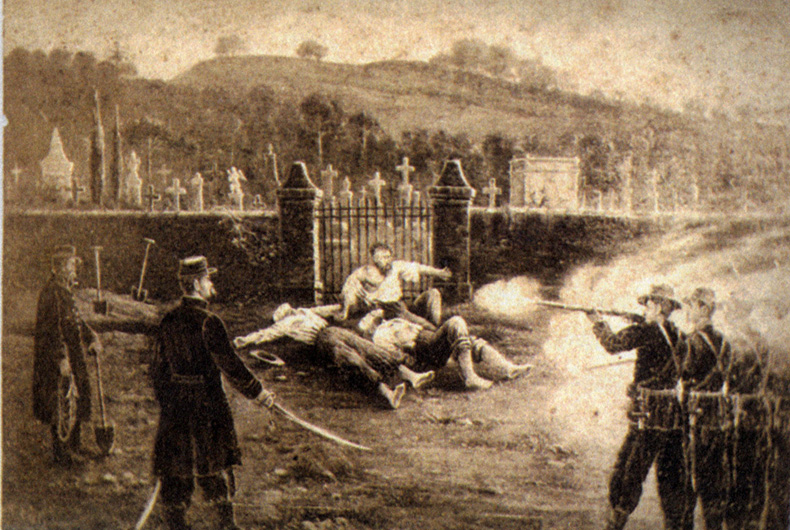
Nas duas últimas colunas, lembramos da invasão dos serranos à Vila de Santa Cruz, em fevereiro de 1894. O fato ocorreu durante a Revolução Federalista (1893-1895), quando um grupo com cerca de 500 revoltosos tomou a Intendência e a Cadeia. Eles foram expulsos dez dias depois, mas os reflexos do embate dos federalistas (maragatos) e republicanos (picapaus) permaneceram por um bom tempo, até com fuzilamento de pessoas.
A tropa rio-pardense, que expulsou os serranos (federalistas) comandados por Zeca Ferreira, permaneceu aqui por algumas semanas. Ela se retirou em 7 de junho de 1894 e foi substituída por uma força regular comandada pelo coronel republicano Antônio Carlos Chachá Pereira, apoiador de Júlio de Castilhos e com fama de disciplinador.
Chachá instalou-se na Intendência (Palacinho). Os 100 soldados que o acompanhavam ficaram em um acampamento na praça. Um dos episódios mais lamentáveis da sua passagem foi o fuzilamento realizado na frente do portão do cemitério municipal, que era onde hoje é a Igreja Evangélica (Rua Venâncio Aires esquina com 7 de Setembro).
Publicidade
How Casino Bonus Regulations in Canada Have Evolved Over Time, According to Casizoids
The Canadian online gambling landscape has undergone a significant transformation over the past two decades, and nowhere is this more visible than in how casino bonuses are regulated and disclosed to players. What began as a largely unregulated space dominated by offshore operators has gradually shifted toward a framework of provincial oversight, consumer protection requirements, and increasingly specific rules governing how promotional offers — including welcome bonuses, free spins, and loyalty rewards — can be structured and advertised. Understanding this evolution requires looking at both the legal architecture that governs gambling in Canada and the practical changes that have reshaped what players actually experience when they log into an online casino.
The Early Years: A Regulatory Vacuum and the Offshore Era
For most of the 1990s and early 2000s, online casino gambling in Canada existed in a legal grey zone. The Criminal Code of Canada, which dates back to 1892 in its earliest form and was substantially revised in 1985, assigned authority over gambling to provincial governments but did not explicitly address internet-based gaming. This ambiguity meant that offshore operators — primarily licensed in jurisdictions like Malta, Gibraltar, Kahnawake (a Mohawk territory in Quebec that established its own gaming commission in 1996), and later Curaçao — could accept Canadian players without facing consistent enforcement action.
During this period, casino bonuses were essentially unregulated from a Canadian consumer protection standpoint. Operators set their own terms, and wagering requirements — the multipliers players must meet before withdrawing bonus-derived winnings — ranged from reasonable to predatory. Requirements of 50x, 60x, or even higher were not uncommon, and the terms were frequently buried in lengthy documents that few players read in full. There were no standardized disclosure requirements, no mandatory cooling-off periods, and no provincial body with clear jurisdiction to investigate complaints about misleading bonus offers. Players who felt deceived had limited recourse beyond disputing charges with their credit card providers.
Publicidade
The Kahnawake Gaming Commission, established in 1996, was one of the earliest licensing bodies to serve Canadian-adjacent operators, and while it introduced some baseline conduct standards, its enforcement mechanisms were limited and its primary function was licensing rather than consumer-facing bonus regulation. The period from roughly 1996 to 2010 was characterized by rapid market growth, minimal oversight, and bonus structures designed almost entirely to maximize operator advantage.
Provincial Monopolies Enter the Digital Space
A meaningful shift began when provincial lottery corporations started launching their own regulated online casino platforms. British Columbia’s PlayNow.com launched in 2004, making it one of the earliest provincially operated online gambling sites in North America. Ontario’s OLG expanded its digital offerings progressively through the 2010s, and Quebec’s Loto-Québec launched Espacejeux in 2010. These provincially run platforms operated under explicit government oversight, which meant their bonus structures were subject to public accountability in ways that offshore operators were not.
On these provincial platforms, bonus offers tended to be more conservative but also more transparent. Wagering requirements were typically disclosed upfront, promotional terms were written to comply with existing provincial consumer protection legislation, and players had access to formal dispute resolution mechanisms. However, the provincial platforms captured only a fraction of the Canadian market — estimates from the mid-2010s consistently suggested that the majority of Canadian online gamblers continued to use offshore or grey-market sites, where the bonus landscape remained far less regulated.
Publicidade
Researchers and advocacy organizations tracking responsible gambling noted during this period that the disparity between regulated and unregulated bonus practices was a significant consumer protection concern. Organizations like the Responsible Gambling Council published reports highlighting how aggressive bonus structures on unregulated sites could exacerbate problem gambling behaviors, particularly when bonuses were tied to deposit matching that encouraged players to wager more than they had originally intended.
Ontario’s iGaming Market Opens: A Turning Point for Bonus Regulation
The most consequential regulatory development in recent Canadian gambling history occurred on April 4, 2022, when Ontario became the first province to open a regulated, competitive private online gambling market. Under the framework established by iGaming Ontario — a subsidiary of the Alcohol and Gaming Commission of Ontario (AGCO) — private operators could apply for registration to legally offer online casino and sports betting services to Ontario residents. By mid-2023, over 70 operators had registered in the Ontario market, representing a fundamental shift from the provincial monopoly model.
The AGCO’s Registrar’s Standards for Internet Gaming, which govern all registered operators in Ontario, introduced specific requirements around how bonuses and promotional offers must be presented. Operators are required to clearly display all material terms of a bonus before a player opts in, including wagering requirements, game restrictions, time limits, and maximum withdrawal caps. The standards explicitly prohibit operators from using bonus structures in ways that could be considered misleading or that obscure the true conditions attached to an offer. Advertising standards also require that bonus claims in marketing materials be substantiated and not create a false impression of value.
Publicidade
For players and analysts who track the industry, platforms like Casizoids have documented how these regulatory changes have affected the practical structure of bonus offers available to Canadian players, particularly in Ontario. Wagering requirements on AGCO-registered platforms have generally trended lower than what was historically common on offshore sites, with many operators now advertising requirements in the 25x to 35x range rather than the 40x to 60x figures that were widespread in the unregulated era. Those who want to understand how current bonus terms compare across registered operators can find out more through resources that specialize in tracking and analyzing these offers within the regulated Canadian market.
The Ontario model has also introduced requirements around responsible gambling integration with bonus systems. Operators must ensure that players who have set deposit limits or self-exclusion parameters cannot receive bonus offers that would effectively circumvent those protections. This represents a meaningful technical and policy integration between bonus marketing and responsible gambling infrastructure — something that was entirely absent in the offshore era.
Ongoing Challenges and the Path Toward Broader Harmonization
Despite Ontario’s progress, the regulatory picture across Canada remains fragmented. As of 2024, no other province has replicated Ontario’s competitive private market model, meaning that residents of British Columbia, Alberta, Quebec, and other provinces still navigate a landscape where provincially operated platforms coexist with offshore sites that operate without Canadian provincial licenses. This creates an uneven playing field for bonus regulation — a player in Ontario interacting with a registered operator faces a meaningfully different disclosure environment than a player in Alberta using an offshore platform with no provincial oversight.
Publicidade
Casizoids and similar analytical platforms have noted that this fragmentation creates practical confusion for Canadian players, who may not always be aware of which regulatory framework — if any — applies to the platform they are using. A bonus advertised on an offshore site may look superficially similar to one on a registered Ontario platform, but the underlying terms, the enforceability of those terms, and the recourse available to a player who disputes the outcome can differ substantially.
There have been ongoing discussions at both the federal and provincial levels about whether a more harmonized national framework for online gambling regulation is feasible or desirable. The federal government amended the Criminal Code in August 2021 to legalize single-event sports betting (previously only parlay betting was permitted), which demonstrated that federal legislative action on gambling is possible. Some legal scholars and industry observers have argued that a similar federal intervention could establish baseline standards for online casino bonus disclosure and consumer protection that would apply across provinces, though this remains a subject of policy debate rather than imminent legislation.
The advertising environment has also come under increasing scrutiny. The Canadian Radio-television and Telecommunications Commission (CRTC) and the Competition Bureau have both been involved in discussions about how gambling advertising — including bonus promotions — should be governed across broadcast and digital media. The advertising standards that apply in Ontario under the AGCO framework do not automatically extend to media consumed by residents of other provinces, creating further complexity for operators and regulators alike.
The evolution of casino bonus regulation in Canada reflects a broader tension between consumer protection, provincial jurisdiction, and the practical realities of a market where a significant portion of gambling activity continues to occur on platforms outside any Canadian regulatory framework. Ontario’s 2022 market opening represents the most substantive regulatory advancement to date, establishing concrete standards for bonus transparency and responsible gambling integration that have materially changed what players in that province experience. Whether other provinces will follow with similar frameworks, and whether any federal harmonization effort will gain traction, will determine whether Canada moves toward a coherent national approach or continues to operate as a patchwork of provincial regimes alongside a persistent offshore sector. For players, the practical implication is clear: understanding which regulatory framework governs the platform you use is as important as reading the bonus terms themselves.
Segundo pesquisa do saudoso professor Hardy Martin, soldados prenderam três homens que supostamente estariam indo ao encontro de Zeca Ferreira (maragato e inimigo de Chachá) em Quatro Léguas (divisa de Santa Cruz e Soledade). Eles foram interrogados, mas como só falavam alemão, o coronel concluiu que eram espiões e os condenou à morte.
O vigário da vila, padre Forrer, conversou com os três, que estavam presos na Intendência. Dois encontravam-se amarrados em uma estaca e outro em um canhão. Não há registros sobre eles, mas é possível que fossem colonos serranos que vieram à vila a negócios.
Um observador desenhou a cena do fuzilamento. Ele só não foi fiel ao retratar o ambiente, pois os morros que aparecem no fundo do cemitério não existiam. Chachá Pereira ficou na vila por mais de mês, deixando os moradores preocupados com suas arbitrariedades. Ele era natural de Taquari, foi militar e deputado estadual castilhista. Participou de combates contra os federalistas (apoiadores de Gaspar Silveira Martins) e morreu em 1904.
Fontes: Gazeta do Sul e pesquisa do prof. Roberto Radünz